
Most small business owners hear the word "AI" and immediately think one of three things: it's too expensive, it's too complicated, or it's built for someone else. A tech startup in San Francisco, maybe. A corporation with a dedicated IT team. Not a bakery in Birmingham or a physio clinic in Leeds.
That thinking is understandable. But it's also the thinking that's quietly putting some businesses behind their competitors right now - and the gap is widening every month.
This isn't a piece about the future of AI. It's about what's happening right now, today, and what practical difference it can make to a small business that's willing to pay attention.
The shift has already happened
AI didn't arrive with a single announcement. It crept in - quietly, steadily - through the tools people were already using. The email platform that now drafts replies for you. The accounting software that flags anomalies automatically. The social media scheduler that suggests optimal posting times. The customer service widget that handles common questions before a human ever gets involved.
If you've used any of these features without thinking twice about them, you've already been using AI. The question isn't whether to engage with it - you already are. The question is whether you're using it intentionally, or just occasionally stumbling across it by accident.
The window to get ahead of your competitors isn't closing - but it is narrowing. The businesses that move now will set the standard. Everyone else will be playing catch-up.
What AI actually means for a small business
Let's be specific. AI for small businesses isn't robots. It isn't replacing your team. It isn't some complex system that requires a developer to set up and maintain. At the practical level - the level that matters to a business with five employees or fifteen - it looks like this:
-
Customer enquiries answered faster: Tools like AI-assisted email drafting or chatbots can handle the first response to common questions, freeing you up for the conversations that actually need you.
-
Content created in a fraction of the time: First drafts of blog posts, social captions, product descriptions, email newsletters - all of these can be generated, refined, and published in the time it used to take just to stare at a blank page.
-
Admin that runs itself: Invoice follow-ups, appointment reminders, data entry, report generation - routine tasks that used to eat hours can be automated with tools that cost less per month than a single hour of staff time.
-
Better decisions, faster: AI tools can analyse your sales data, your website behaviour, your customer patterns and surface insights that used to require a consultant or a spreadsheet expert.
None of this is science fiction. All of it is available right now, to any business willing to spend a few hours getting set up.
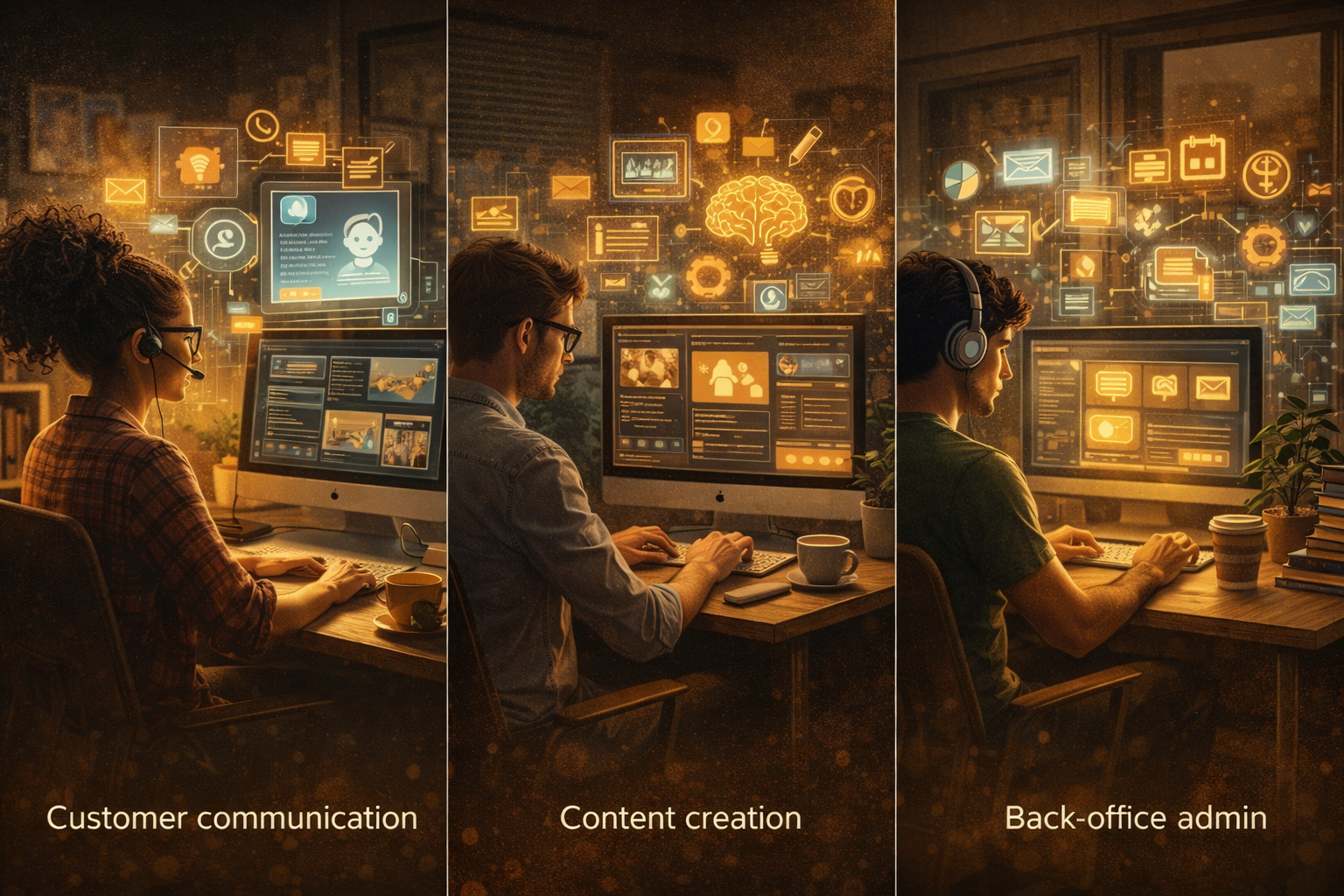
The three areas where it moves the needle most
If you're starting from scratch with AI, these are the three areas where small businesses consistently see the biggest return on their time investment.
1. Customer communication
Speed of response is one of the biggest factors in whether a lead converts. Research consistently shows that responding to an enquiry within five minutes is dramatically more effective than responding within an hour - let alone the next day. AI-assisted inbox tools, auto-responders, and chatbots don't just save time. They make you faster than competitors who are still replying manually.
2. Content creation
Marketing is the thing most small business owners know they should be doing more of, and consistently don't. Not because they don't care - because they don't have time. AI doesn't write your content for you. But it does remove the blank page, the structuring, the first draft - which is where most of the friction lives. A business that was posting twice a month can start posting twice a week. That compounds over time in ways that are hard to overstate from an SEO and brand awareness perspective.
3. Back-office admin
This is unglamorous but it's where the hours go. Chasing invoices. Scheduling. Data entry. Summarising meetings. Organising inboxes. Every hour spent on admin is an hour not spent on the work that actually generates revenue. Automation tools - many of which now have AI built in - can handle a substantial portion of this with minimal setup time.
The biggest mistake small businesses make with AI
They wait until they understand it better.
This is completely understandable. AI moves fast, the landscape is confusing, and nobody wants to invest time in something they're not sure about. But the truth is that the best way to understand AI is to use it. Reading about it, watching videos about it, attending webinars about it - none of these things will teach you as much as spending thirty minutes actually trying a tool.
Start small. Pick one area of your business - your inbox, your social content, your invoicing - and find one tool that addresses it. Use it for a month. See what you learn. Then expand from there.
The businesses that are furthest ahead with AI right now aren't the ones with the biggest budgets or the most technical expertise. They're the ones that started early and stayed curious.
One thing to do this week
If you've read this far and you're not sure where to begin, here's a simple starting point: write down the three tasks in your working week that you find most repetitive and most time-consuming. Then search for an AI tool that addresses one of them.
You don't need a strategy. You don't need a roadmap. You just need to start. The understanding comes from doing - and the doing, once you begin, tends to build its own momentum.
If you'd like a hand figuring out where AI fits in your specific business, that's exactly what we do at Nutmilk. No jargon, no overwhelm - just a practical conversation about what would actually make a difference.